Custom Harmonicas by Andrew Zajac
The most expressive harmonicas

Main navigation

  • Home
  • Custom Harmonicas
  • My Combs
  • Tool Kits and Accessories
  • Learning Products
  • Blog
  • Service
  • Dealers
  • About
  • Contact

Breadcrumb

  • Home

Mysterious embossing instructions - Can you see the light?

By Andrew | 6:09 PM EST, Sat January 10, 2015

I offered some Mysterious Embossing Instructions which included a clue you can download and print out.

This video explains the clue I gave, my reason for offering it in this way and a demonstration of how I use indirect light and a three-dimensional view to make quick and effective work of embossing harmonica slots.

With this method, you get benefits similar to using a microscope and a light-table but avoid the respective disadvantages and limitations of those devices.

  • Read more about Mysterious embossing instructions - Can you see the light?

Tweaking harmonicas: Measure what you change

By Andrew | 5:02 PM EST, Tue November 11, 2014

This is about methodology.

I made yet another harmonica tweaking video.

Here's a video demonstrating some of the things that are straightforward to quantify so that you can make changes that have a measurable benefit.

Some of these things include:

Tuning: It's easy to measure the pitch of a reed and whether it's in tune with another reed. Play all the octaves available and listen for "beating".

Bending: Bend the 3 draw (or any other bend) with as little force as you possibly can. You will find a "blind spot" somewhere in the middle where the workload is handed off from the draw reed to the blow reed as you bend down. How much work is needed to "skip over" this blind spot can be felt, albeit subjectively; it tends to be more work on lower key harps. We learn to "skip over" this blind spot early on when we are learning to bend. A well-playing harp can be played with very little breath force without having to work hard around the "blind spot".

Reed shape efficiency: By playing a single reed using your lips on the plate off the comb, you can get sensory feedback on how easily the note responds, how much flow you need to make the note sound strong, and how loud the note is. A well-shaped reed will make the whole reed plate vibrate when you play it.

Reed shape efficiency (again): By bending the single reed's note down, you can determine if the reed is prone to squealing. That's a great indicator of how efficiently the reed is set up.

Front
  • Read more about Tweaking harmonicas: Measure what you change

Research and development of optimized combs

By Andrew | 11:20 AM EDT, Mon June 16, 2014

I have an ongoing process of quality improvement and I devote some time and resources for research and development on certain projects. I've enlisted the help of a number of players to do some testing. I need the input of different players to determine if a particular change to a comb design is indeed an improvement that can be measured.

In cases where the improvement is felt across the board, the change becomes part of my standard design.

In some cases, the change is subjective. Some may love it while others may hate it. In that case, I can offer the new feature as an option so that customers can get a truly customized comb, made to order with or without any desired design tweaks.

I recently had some testers compare two combs. Both were identical except for the hole spacing. The Hohner Rocket boasts wider spaced holes and I wanted to provide that experience without making the comb tines too thin.
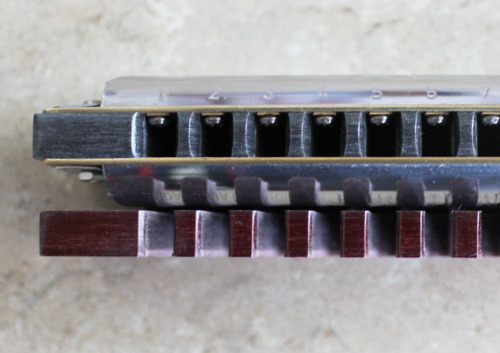

Wide openings and standard openings

The tines are only thin at the opening and become a normal spaced channel to provide less compressible volume a little further down. This is to improve responsiveness. The hole openings are 40 per cent wider than standard Marine Band comb openings.
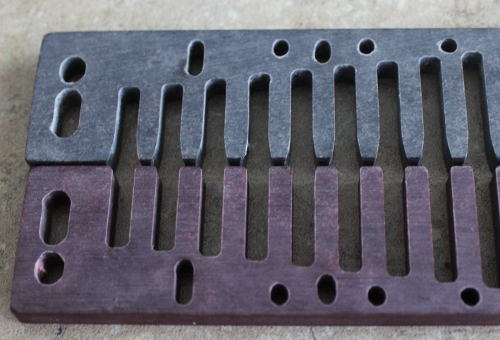
Feedback is trickling in and I am considering it carefully.

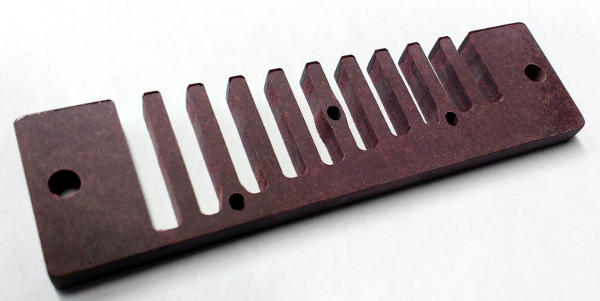
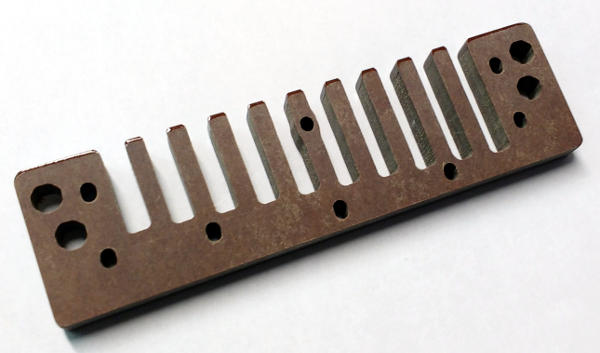
My next test will involve resonance chambers. I feel the consensus is that thinner combs offer better response because there is a smaller compressible volume between your lips and the reeds. But thicker combs offer a larger resonance chamber and some prefer the tone of a thicker comb. Here is not-too-thick comb with enlarged resonance chamber. The aim of this design is to get the sound of a thick comb with the responsiveness of a thin comb.
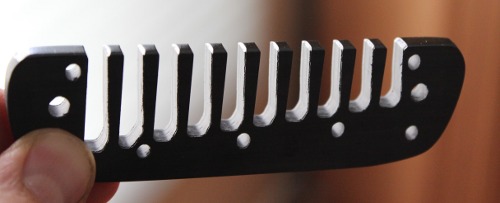

Comb with built-in resonance chambers
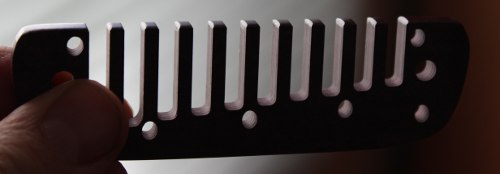

Comb with standard shaped tines

I will be looking for more testers in the near future. I need to finish getting feedback from the first test as well as tweak the "resonance chamber" design before I call for more testers. Stay tuned!

***Update 2016/05***

I have come to the conclusion that resonance chambers have no real benefit and some drawbacks, namely that they can interefere with the performance of some bends/overbends. The original, classic comb design with straight chambers provides the best, smoothest performance.

Although this doesn't result in any innovation, it does provide some helpful evidence as to what makes a harp play well. I believe this project was time well spent.
  • Read more about Research and development of optimized combs

Acrylic (Plexiglass) harmonica parts

By Andrew | 3:56 PM EDT, Sat May 17, 2014

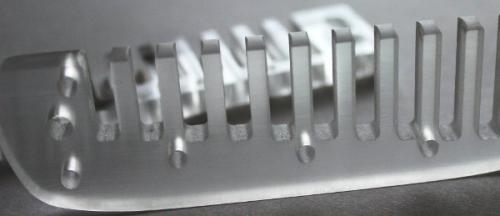
Acrylic is horrible on the environment to make in terms of the chemicals that are put into the air but it is sustainable once it is produced. It can be recycled or re-purposed. That being said, my community does not recycle acrylic. It goes into landfill.

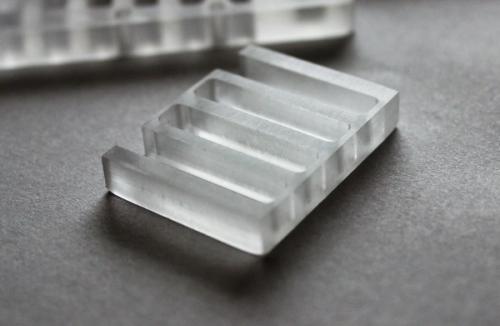
So when I stumbled upon a small amount of discarded Plexiglass, I decided to give it a new home. After some tinkering, I found a way to produce some pretty nifty combs and French Tuners!

Once the sides are flat-sanded for air tightness and the tips finished to a smooth matte surface, they look like they are made of ice. Canadian-made ice combs for sale!

I am offering these combs at budget prices. They look terrific, offer quick response and sound great, but they don't offer the same juicy timbre as my Dark combs. They are most certainly a huge upgrade from stock combs and will add some punch to your harps.

If you want a comb that gets the job done at an economical price, this is the comb for you.

Limited quantities available. Click here to order. (Sold out!)

  • Read more about Acrylic (Plexiglass) harmonica parts

Playing a harp while giving out advice

By Andrew | 9:56 AM EDT, Sat April 19, 2014

My wife says I look like a clapping seal.

Yes, I do.

Front
  • Read more about Playing a harp while giving out advice

Video: Replace Marine Band nails with screws and install new comb

By Andrew | 9:09 PM EST, Sun March 02, 2014

This is a quick and easy way to install a flat comb in to a Marine Band harmonica. The stock comb has dimples to make room for the ends of the rivets which hold the reeds. My combs provide more surface area to make an airtight seal with the reed plates and the rivet ends need to be flattened.

This is a harp in the key of G. The end result is a fantastic harmonica that is loud and responsive. I was happy with the instrument but was not satisfied with the 4 overblow due to the shape of the reeds (out-of-the-box profiles).

I spent a few minutes and did some re-shaping of the blow and draw reeds to make them more efficient. It's much more work than just gapping. But the end-result is a 4 blow that is not tight and plays normally with hard pressure as well as a solid - and bendable - 4 overblow.

Front
  • Read more about Video: Replace Marine Band nails with screws and install new comb

Other models including Marine Band 364, 365, pre-MS Meisterklasse, Seydel Big Six, Easttop 008

By Andrew | 11:01 AM EST, Fri January 31, 2014

Made to order.

Models currently available for immediate production include:

Original Hohner Meisterklasse (pre-MS)

Marine Band 365 (Convert to screws)

Marine Band 364 (Convert to screws)

  • Read more about Other models including Marine Band 364, 365, pre-MS Meisterklasse, Seydel Big Six, Easttop 008

Lee Oskar

By Andrew | 10:54 AM EST, Fri January 31, 2014

Fits Lee Oskar harmonicas.

  • Read more about Lee Oskar

Suzuki

By Andrew | 10:52 AM EST, Fri January 31, 2014

Fits the following harps:
Suzuki Manji, Promaster, Suzuki Olive.

Also fits
- Dabell Contender
- Dabell Noble
- Suzuki HarpMaster, BluesMaster (*)
- Bushman Delta Frost(*)

The stock Manji comb is slightly smaller than the reed plates. My comb is a hair bigger than the plates so that the harp is more comfortable to hold.

HarpMaster, BluesMaster:

  • Read more about Suzuki

Seydel 1847

By Andrew | 10:50 AM EST, Fri January 31, 2014

Fits Seydel 1847, SOLIST PRO and FAVORITE

More information and instructions for installing my combs are found on the Combs page.

  • Read more about Seydel 1847
Pagination
  • First page « First
  • Previous page ‹ Previous
  • …
  • Page 7
  • Page 8
  • Page 9
  • Page 10
  • Page 11
  • Page 12
  • Current page 13
  • Page 14
  • Page 15
  • Next page Next ›
  • Last page Last »
Subscribe to

User account menu

  • Cart
  • Log in

Custom diatonic harmonicas, Hohner Affiliated Customizer.
I customize Hohner Marine Band, Rocket, and Special 20 harmonicas.
Andrew Zajac, Kingston Ontario, Canada.
I use a continuous quality improvement process. I use regular evaluation and incremental steps to strive for constant improvement.
Website, text, photos, videos, download documents, designs and products by Andrew Zajac are licensed under a Creative Commons Attribution-ShareAlike 4.0 International License.
Terms of use

Copyright © 2026 Andrew Zajac - All rights reserved