I strongly recommend you obtain and use The Flatness Tool™ and Reed Plate Claws™ to straighten both the blow and draw reed plates. These are fine harps, but they suffer a little more from the difficulties associated with mass production than a higher quality harp.
I recommend the ones with riveted reeds. There is no advantage to spot-welding reeds unless they are put on perfectly centred at the base from the factory. They are not. Riveted reeds can more easily be centred at the base than spot-welded ones.
I also found Easttop tuning to be quite imprecise. Tuning was plus or minus six cents! As such, it's not possible to lay out a meaningful tuning table of offsets for these harps.
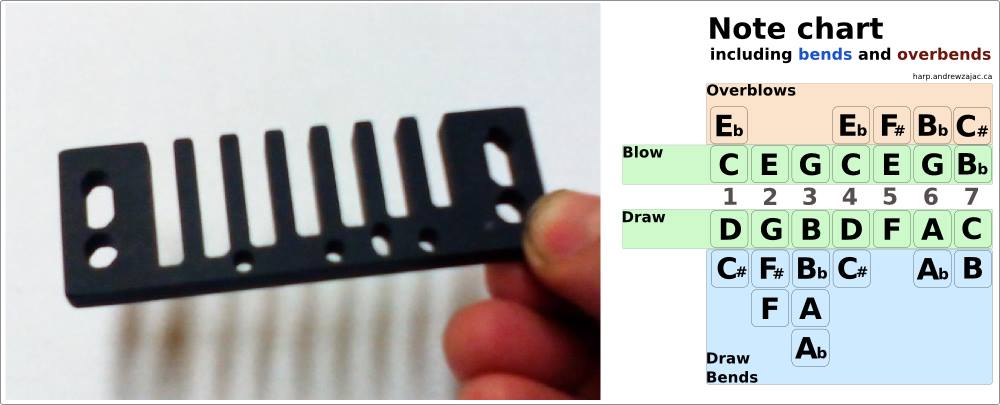
This is a custom comb I first made in February 2016
You can tune the 7 hole any way you like. Here, by lowering the 7 blow, we gain a draw bend. Add 7 blow into the top end blow chord and you get a minor seventh.
You can modify a standard cover plate to fit by trimming away the top end and doing a little folding and smoothing. Sorry, I don't have a photo of the finished product.
Barry bought my tool kit and overdid it on a reed. In this video I will show you the steps I take to correct this problem using pressure and counter pressure.
Would you like me to make a video about your "best" mistake? Contact me and let me know your ideas!
This is a one-time-offer. The price is for the lot (plus a few extra goodies).
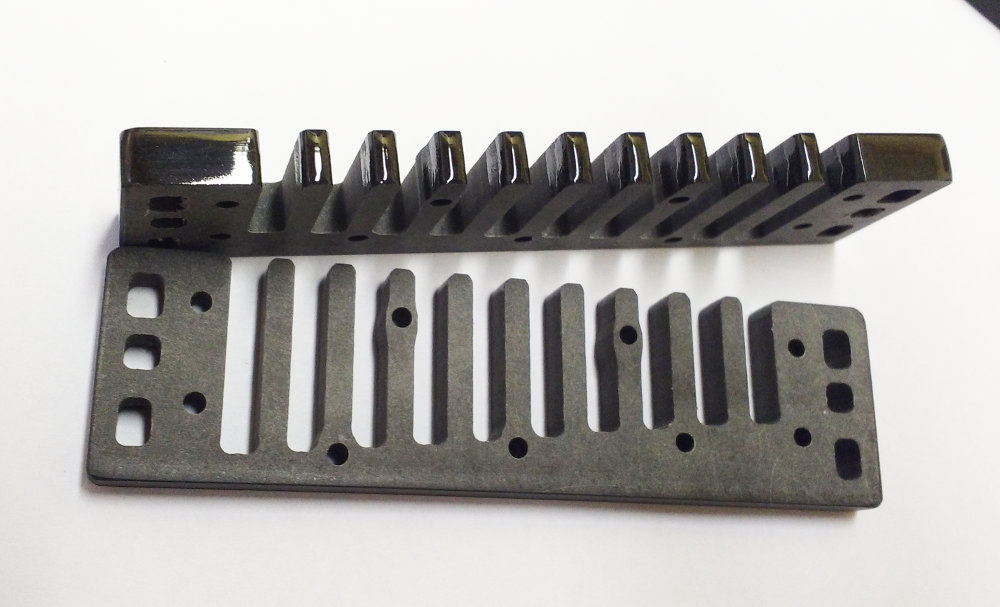
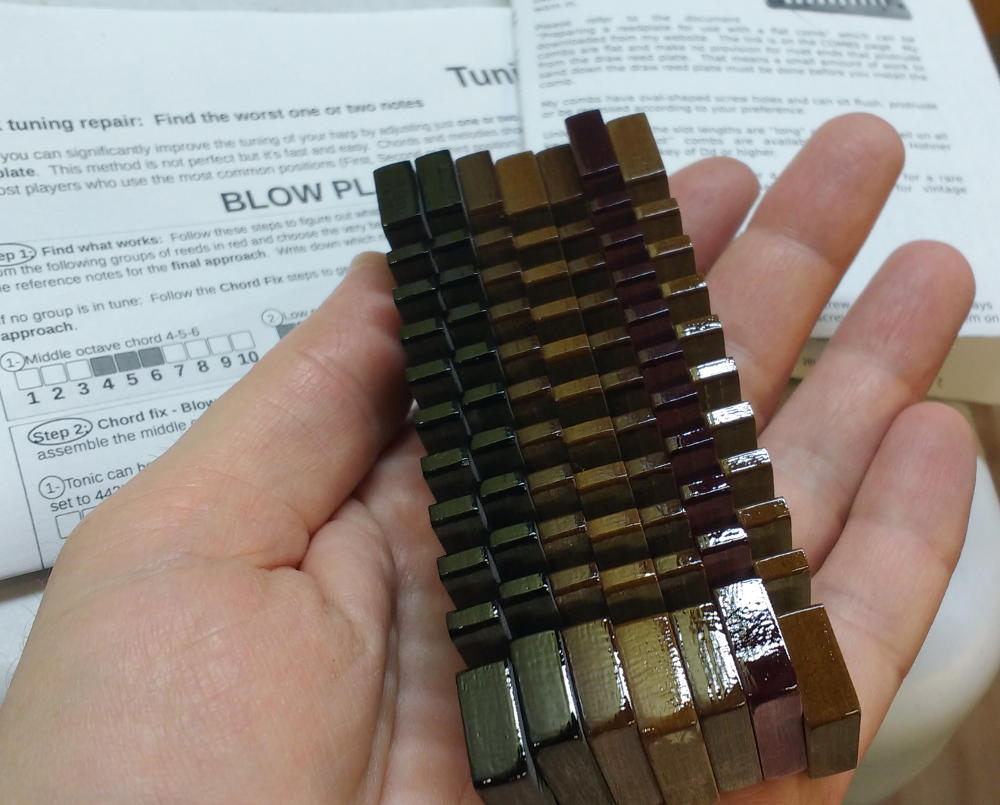
I make mistakes. These combs all have slight cosmetic defects due to my mistakes (you may not even notice). They all are 100 per cent functional - none of the problems will affect how these combs perform. I use combs like these for my personal harps.
I guess I make a few more mistakes than I have harps.
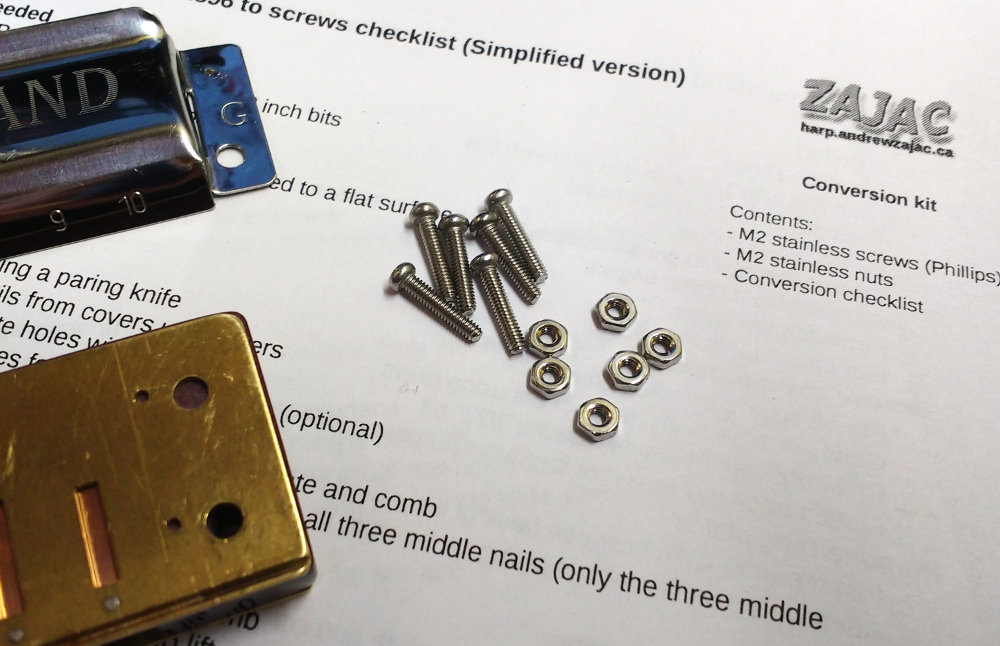
New Version - this product now ships with enough screws and nuts to convert five Marine Band harmonicas
Support is included!
With the purchase of this product, you get full access to the information you need to get the job done. Just ask! I will help you through the process via email if you need assistance
This is part of a series of checklists I am making available to you.
Click the "Printer-friendly version" link at the bottom of the page and feel free to print out as many copies as you like!
----------
Basic embossing checklist
(Half slot embossing)
version 2016/12/13
Items needed
___ Tools to disassemble the harmonica (screwdriver)
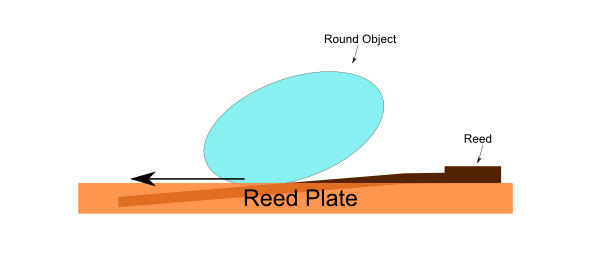
___ A hard round object (Example, a chrome-plated socket) or a specialized Embossing tool
___ Plinking tool
___ Reed work or gapping tool
___ Reed wrench Prep work
___ The harp is airtight
___ The reed shapes are favorable
___ Gaps are set
___ The harmonica plays well (Embossing will never, ever fix a problem) Embossing
___ Take the harmonica apart
___ Lay reed plates reed-side-up on a flat surface
___ Press the Embossing tool or round object into the middle of a slot. Advance to the tip (not the base) using gentle downward force
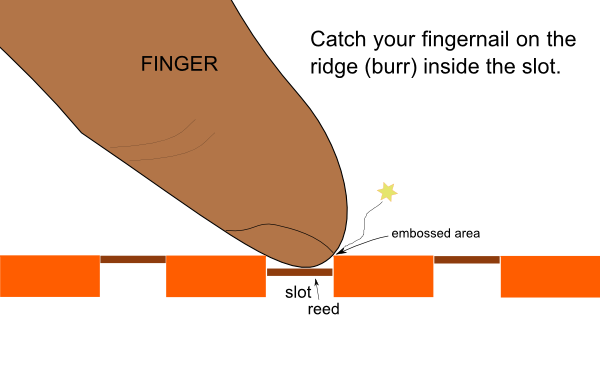
___ Use your fingernail to feel for a catch on the inside of the slot. If none is present, repeat the previous step with slightly more downward force.
___ Plink the reed to make sure you didn't use too much force and over-do it.
___ Repeat the process for the other slots Troubleshooting
___ If the reed won't plink, consider reed alignment.
___ If you embossed too much, apply pressure to "un-do" the embossed ridge using the reed tool or the plinker. Look through the slot and press the tip of the reed through. Can you see where the reed is contacting the slot? Apply gentle pressure to the slot wall in that area.
Here's a way to fix tuning problems that goes straight to the heart of the problem. Don't worry about temperament. Forget about the numbers. Use your ears to figure out what's wrong.
The goal here is to only tune the worst one or two reeds on the reed plate.
The trouble with "hunt-and-peck" tuning is that you can make things worse if you tune reeds at random. If two reeds are out-of-tune with one another, which one do you adjust? Do you focus on chords or on single notes?
Use this opportunity to decide what sounds good to your ears. If you have trouble deciding if something sounds good, an out-of-tune harp will make it easy for you to hear what sounds bad!. This will help you identify what is in tune and replicate it to the rest of the reed plate.
Method:
- Divide the blow plate into three octaves. Play 456 as a chord. How does it sound to your ears? Do the same with 123 and compare. Which one sounds most in tune? If you are in the habit of playing chords on the top octave, try the 789 and 10 hole chord.
- If one octave's chord is much better than the others use it as a reference. If all the chords are bad, break down the 456 chord by intervals (tonic octave - 1-4 blow, thirds - 4-5 blow, and fifths - 4-6 blow). Consider what reed in the 456 you need to change to make it sound nice. Use a piece of paper to write down your plan.
- Play a melody in the middle octave and try to notice if any notes sound off. If you can accompany yourself using a jam track, do so.
If you are in the habit of playing in positions other than First, Second or Third, play a melody in that position and listen to what notes sound out of tune. Compare the same melody in another octave (use the same position.)
- Decide which problem is worse: Do I need to fix chords? or Do I need to fix individual notes?
- Play all the octaves on the blow plate and find the ones that are our of tune.
1-4
2-5
3-6
4-7
5-8
6-9
7-10
You have already determined what reed(s) are the culprit in the earlier steps. Example, if the 1-4 octave sounds bad, but you like all the notes of the 456 chord, then tune the 1 reed to agree with the 4.
- Pick the one or two worst reeds on the plate and fix them. Don't aim for perfection, just make things sound good.
Remember: "Better" is the enemy of "Good". If the tuning is "good", move on and forget about making it "better".
- The process is almost the same for the draw plate. Focus on the 234 draw chord; do not consider any other chords on the draw plate. Play the chord and play a melody. Identify whether the chord or the individual notes are out-of-tune. Adjust individual reeds by using the following octaves:
1-4
3-7
4-8
5-9
6-10
Would you like me to make a video about your "best" mistake? Contact me and let me know your ideas!
A Facebook friend asked about Tuning-Embossing-Shaping. "Knowing when I'm getting tired and/or impatient and knowing when it's time to get up & walk away."
Would you like me to make a video about your "best" mistake? Contact me and let me know your ideas!